How Much Plotter Do You Really Need?
Most buyers start with a model number. Start with square feet per month instead, and the right wide format printer gets a lot easier to pick.
Buying a wide-format printer should be pretty simple. You print 36-inch drawings, so you buy a 36-inch plotter. Done, right? Not quite. That would be like saying you need a vehicle, so any vehicle with four tires should work. A Honda Civic and a Ford F-350 will both get you to the office, but I wouldn’t recommend the Civic if your day includes hauling two tons of concrete. Plotters work the same way.
I’ve been selling wide-format equipment for a long time, and one of the first questions I ask isn’t, “What plotter do you have?” It’s “How much do you print?” That’s where the conversation starts to get interesting, because the answer can completely change the type of machine I recommend.
Start With Square Feet, Not Pages
Copier people talk about pages. Wide-format people should talk about square feet. If your company prints 500 square feet per month, your needs are dramatically different from an engineering firm producing 5,000 or 10,000 square feet every month. Go higher than that, and now we’re having an entirely different conversation.
The problem is that many companies don’t know their monthly square footage. They know they go through paper, somebody is always yelling that the plotter is out of ink, and Monday morning seems to be the exact moment the machine decides it doesn’t want to cooperate. But ask about actual monthly volume and I often hear, “Art, I have no idea.” That’s okay, because we can usually figure it out without bringing in a forensic accounting team.
How Many Rolls Are You Using?
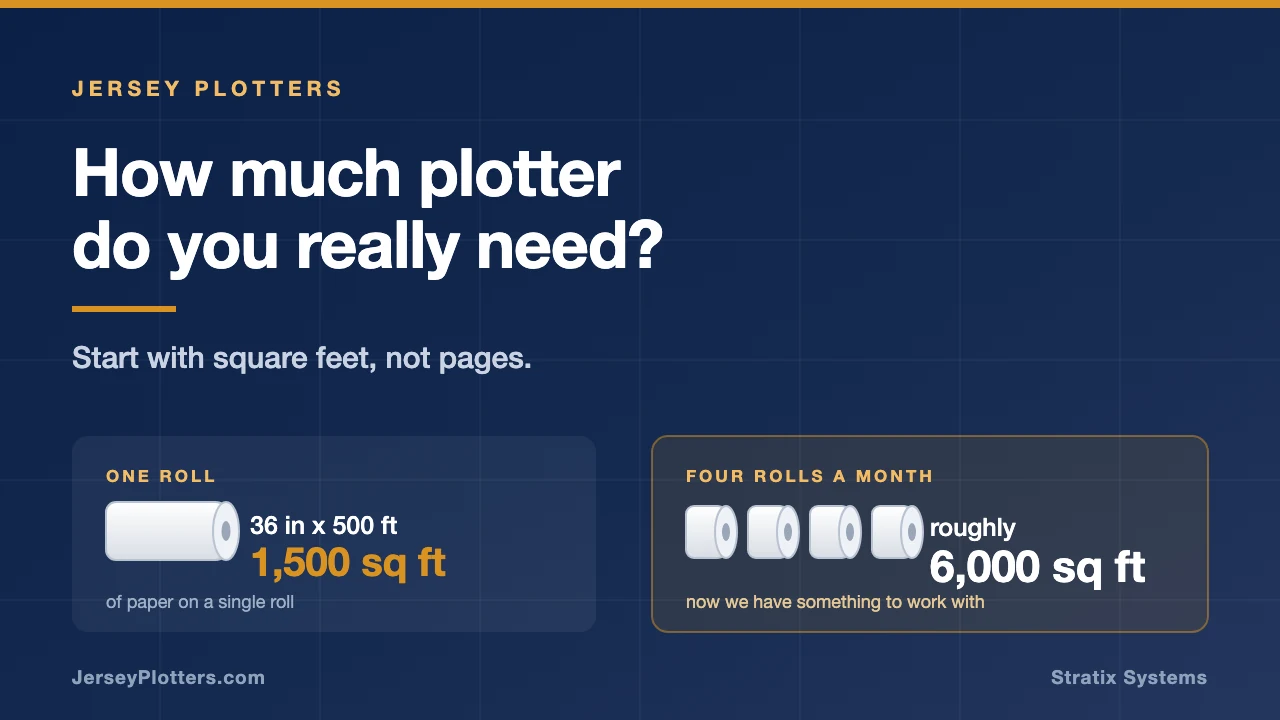
Here’s one of my favorite shortcuts. Instead of asking someone to calculate every drawing they’ve printed for the last six months, I ask how many rolls of paper they use. A common 36-inch x 500-foot roll contains approximately 1,500 square feet of paper, so if you’re going through four of those rolls every month, we’re already talking about roughly 6,000 square feet of potential output. Now I have something useful to work with.
I also want to know what you’re printing, because 5,000 square feet isn’t always 5,000 square feet when we’re talking about operating costs and workload. Are we printing mostly black-and-white CAD drawings, color line drawings, renderings, GIS maps, posters or construction sets? Five thousand square feet of black-and-white CAD isn’t necessarily the same workload as 5,000 square feet of high-coverage color graphics.
Low Volume Doesn’t Mean “Buy the Cheapest Plotter”
This is where buyers can get themselves into trouble. If you’re printing relatively low volume, a smaller wide-format printer may be exactly what you need. Why spend money for production capacity you’ll never use? At the same time, price shouldn’t be the only consideration, because monthly volume only tells me part of the story.
Maybe you only print 1,000 square feet per month, but every Friday afternoon somebody needs five complete sets of drawings before leaving for a job site. Suddenly speed matters. Maybe you don’t print much, but you need to scan old drawings. Maybe your drawings are constantly 30 x 42, while occasionally you need 36 x 48. Maybe you need two rolls loaded because changing paper is apparently the one office chore everyone has collectively decided belongs to somebody else. That’s why volume is the beginning of the conversation, not the end.
As Volume Goes Up, Workflow Matters More
At 500 or 1,000 square feet per month, waiting a little longer for a print may not matter. At 5,000 square feet, it starts to matter, and at 10,000 square feet or more, I want to know how much time employees are spending standing around the plotter, sorting drawings, changing rolls, trimming prints and assembling sets. At that point, we’re no longer having just a printing discussion. We’re having a labor discussion.
This is where features such as dual rolls, faster print speeds, integrated scanning and automatic stacking start making a lot more sense. The more you print, the more important it becomes to look at what happens after the drawing comes out of the machine. If you’ve got an expensive engineer standing next to the plotter manually sorting drawings, congratulations, you may have just purchased the world’s most expensive paper handler.
Don’t Forget the Cost Per Square Foot
The purchase price or lease payment gets everyone’s attention because it’s sitting right there on the proposal, but I want to know what happens after you buy it. What does the ink cost? What’s your estimated ink cost per square foot? What other consumables are involved? What does maintenance cost? Are printheads included? How much paper are you consuming? Most importantly, what does the machine cost to operate at your actual volume?
A machine that’s $3,000 cheaper to purchase isn’t necessarily cheaper to own. Likewise, there isn’t much sense in buying a production machine capable of running circles around your workload if you print two rolls a month. The goal isn’t to buy the cheapest plotter or the biggest plotter. The goal is finding that sweet spot between equipment cost, operating cost, productivity and what your company actually needs to accomplish every day.
So, How Much Plotter Do You Really Need?
Before I recommend a wide-format printer, there are a lot of questions I want answered. How many square feet do you print each month? What percentage is black versus color? What sizes do you print most often? How many rolls of paper do you use? Do you need scanning and copying? Do you need one roll or two? Are people waiting for prints? Do you produce complete plan sets? Do you need stacking? And what are you spending today to produce those drawings?
Once we know those answers, selecting the right plotter gets a whole lot easier. Sometimes the answer is a smaller machine, and sometimes it’s a step up. Sometimes the client thinks they need the biggest, fastest plotter available, and I tell them they don’t. Occasionally, I find someone trying to push production-level volume through a machine that was never designed for that workload, and that’s usually when I hear my favorite technical diagnosis: “This thing is too slow.” Maybe it isn’t. Maybe you simply bought too little plotter.
Before You Buy Your Next Plotter
Don’t start with the model number, the manufacturer’s brochure or the question I hear all the time: “What’s your cheapest 36-inch plotter?” Start with your drawings and your workflow. Figure out what you’re printing, how much you’re printing, how quickly you need it and what you’re paying to produce it today. Once we understand that, then we can talk about the machine.
Because the question isn’t “What’s the best plotter?” The better question is “What’s the best plotter for you?” There is a big difference between the two, and figuring that out before you sign an order can save you money, improve productivity and keep somebody from standing next to the plotter on a Friday afternoon wondering why those five sets of drawings aren’t finished yet.
Jersey Plotters | Stratix Systems
Need help figuring out how much plotter you actually need? Give me your monthly print volume, drawing sizes and workflow, and I’ll help you work through the numbers before we ever start talking about model numbers. Contact me at [email protected] or 732.977.1211