What Is the Cost Per Square Foot for Wide Format Printing?
Learn how to calculate wide format printing costs per square foot and compare in-house printing to outsourced reprographic services.
What Is the Cost Per Square Foot for Wide Format Printing?
One of the most common questions I receive from architects, engineers, surveyors, and construction companies is, “Art, what does it actually cost to print a drawing?” Most people expect a quick answer, but the reality is that very few organizations know their true printing costs. They may know what they spend on paper, toner, service agreements, or even their monthly lease payment, but those individual expenses don’t tell the whole story. The best way to understand wide format printing costs is to calculate the cost per square foot. Once you know that number, it becomes much easier to compare equipment, evaluate outsourcing expenses, and determine whether your current workflow is financially efficient.
Over the years, I’ve found that many companies focus almost exclusively on the acquisition cost of a plotter while paying very little attention to operating costs. Ironically, the purchase price is often one of the smallest expenses over the life of the equipment. What really matters is what it costs to produce drawings month after month and year after year.
The Three Cost Components
For a typical black-and-white LED or toner-based wide format printer, there are three primary components that make up the cost per square foot: paper, toner, and maintenance. Based on current pricing, engineering bond paper averages approximately $0.033 per square foot. Toner costs are relatively low and generally average about $0.01 per square foot. Maintenance agreements, which cover service calls, parts, labor, and preventative maintenance, typically add another $0.028 per square foot.
When these expenses are combined, the total in-house cost comes to approximately $0.071 per square foot. In other words, for just over seven cents, a business can produce one square foot of black-and-white engineering drawings using its own equipment.
In-House vs. Outsourced
What surprises many business owners is how dramatically that compares to outsourcing. Most reprographic companies charge somewhere around $0.35 per square foot for black-and-white engineering prints. Pricing varies depending on volume, turnaround time, and delivery requirements, but thirty-five cents per square foot is a reasonable benchmark for comparison purposes. When a company is producing drawings internally for approximately seven cents per square foot, it becomes clear that the economics can heavily favor in-house printing.
A Real-World Example
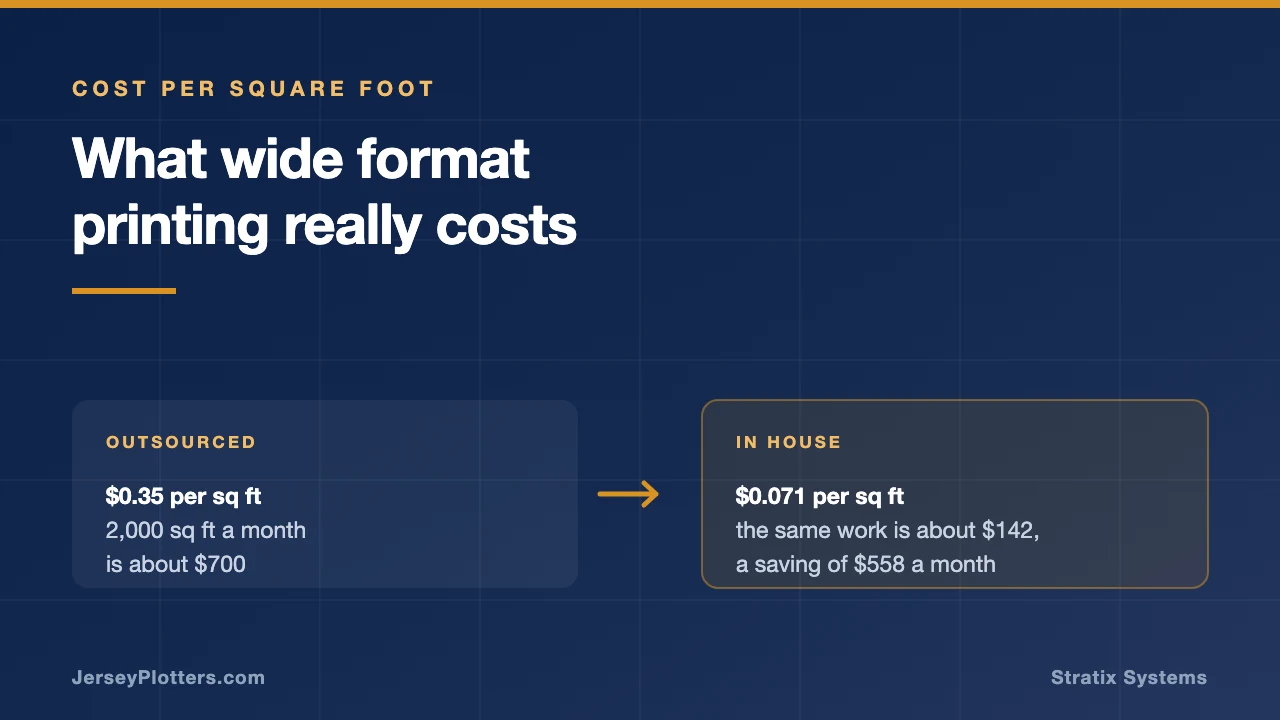
Let’s look at a real-world example. Assume an engineering firm produces 2,000 square feet of drawings each month. At an outsourced rate of $0.35 per square foot, the monthly expense would be approximately $700. Producing those same drawings in-house at $0.071 per square foot would cost about $142. The difference is $558 every month, which adds up to more than $6,600 annually.
Now consider a larger firm printing 5,000 square feet each month. Outsourcing that volume would cost approximately $1,750 per month. Producing the same output internally would cost roughly $355. The annual savings exceed $16,000. At that point, many organizations begin to realize they are spending enough money at local print shops to justify owning a wide format printer and still reducing their overall costs.
The Savings Go Beyond Cost Per Square Foot
The savings, however, go beyond the cost per square foot. When a company owns its own plotter, employees no longer need to drive to a print shop, wait for delivery, or delay projects while drawings are being produced offsite. Revision drawings can be printed immediately, confidential project information remains inside the organization, and project teams gain greater control over deadlines. Those productivity benefits are difficult to quantify, but they often become just as valuable as the direct cost savings.
I’ve worked with numerous architectural and engineering firms that initially assumed a plotter would be too expensive to own. After reviewing their actual print volumes, many discovered they had been spending thousands of dollars each year outsourcing drawings while unknowingly operating well beyond the break-even point for owning equipment. In several cases, the organization could have justified a plotter years earlier but simply never calculated the numbers.
After 46 years in the office equipment industry, I’ve learned that successful businesses understand their costs. They know what it costs to print a drawing, what it costs to outsource a drawing, and where the financial advantages begin to shift. Understanding your cost per square foot is one of the simplest and most effective ways to evaluate whether your current printing strategy makes sense.
If you’re currently outsourcing wide format printing and have never calculated your actual cost per square foot, it may be worth taking a closer look. You may discover that the most expensive part of your printing operation isn’t the plotter at all. It may be the fact that you don’t own one.
Want to Know Your Actual Cost Per Square Foot?
If you’re an architect, engineer, surveyor, contractor, or facilities manager and would like help calculating your actual wide format printing costs, I’d be happy to help. In many cases, a simple review of your monthly print volume can reveal whether you’re spending more than necessary on outsourced drawings.
After 46 years in the office equipment industry, I’ve helped organizations throughout New Jersey evaluate wide format workflows, compare in-house versus outsourced printing, and select the right equipment based on their actual needs rather than marketing claims.
If you’d like a complimentary cost-per-square-foot analysis, send me an email. You might be surprised by how much you’re spending, and how much you could save.
Art Post Wide Format Specialist 📧 [email protected]
For many firms, the biggest printing expense isn’t paper, toner, or maintenance.
It’s not knowing the numbers.